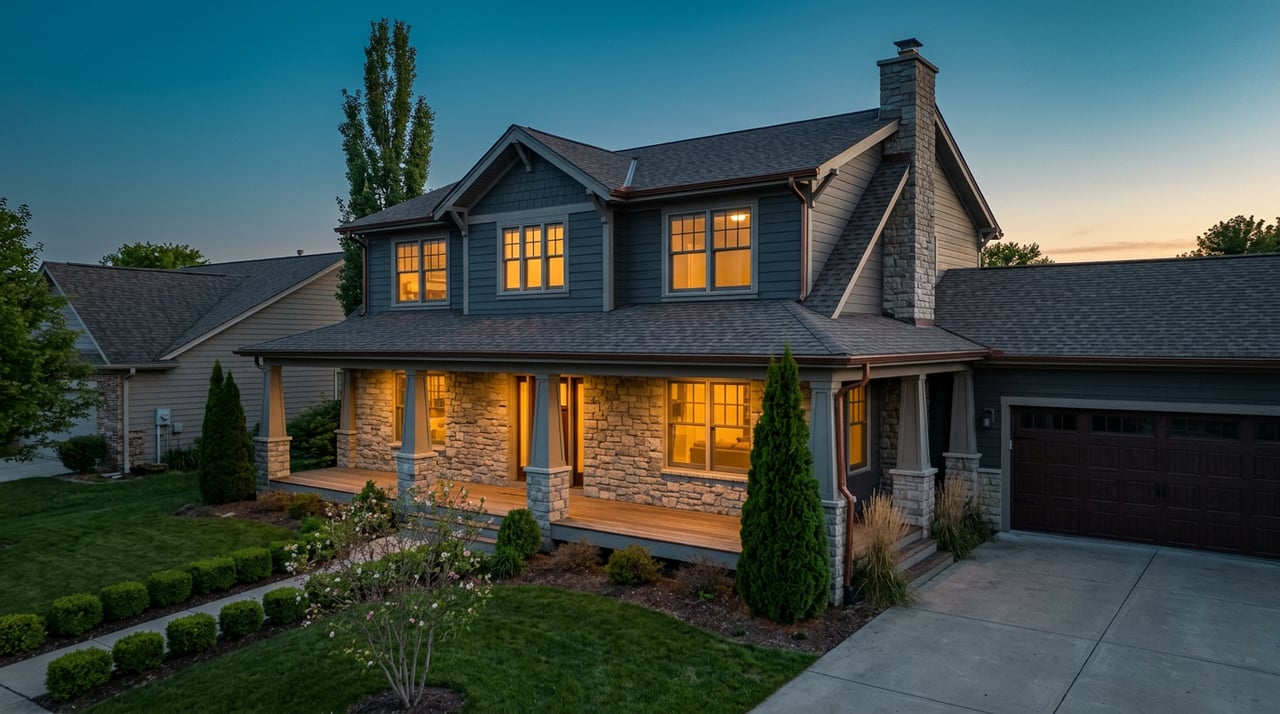
A buyer closes on a brick bungalow in Alger Heights this fall. The listing showed a tax bill of roughly $2,400 a year, based on what the seller had been paying for the past decade. The buyer budgets accordingly, locks in a payment, and moves in. Then the following year, the county mails a bill closer to $4,000.
Nothing went wrong. No one made a mistake. The buyer just ran into a mechanic built into Michigan law that has nothing to do with which neighborhood they picked, what the house looked like, or how good their agent was. It shows up regardless of whether you buy in a $260,000 starter home or a $600,000 Heritage Hill Victorian, and it explains why the seller's tax bill on a listing sheet is one of the least reliable numbers in the entire transaction.
That mechanic, and the fact that "the Grand Rapids median price" describes at least four structurally different housing markets stacked on top of each other, are the two things worth understanding before you write an offer here.
The Number Six Websites Can't Agree On
Pull up six market reports on Grand Rapids home prices this week and you will get six different numbers. One recent local market report put the city's own median sale price at about $300,000 for the three months ending June 2026, up roughly 3.4 percent year over year. A separate industry report for the same June period put the median closer to $334,950, up 6.33 percent year over year. Other trackers land anywhere between $268,540 and $335,000 depending on whether they are measuring the city proper, the wider metro footprint that stretches into Ada, Cascade, and Rockford, or a rolling average versus a strict three-month sale window.
None of these numbers are wrong. They are measuring different geographies and calling the result the same thing. The city proper skews toward older, smaller housing stock built before 1970. The metro figure folds in newer construction and larger lots in the surrounding townships, which pulls the average up. Once you understand that the spread comes from geography, the real question stops being "what's the median" and starts being "which Grand Rapids am I actually looking at."
That question has a real answer, and it splits the city into at least four submarkets that behave nothing alike.
Four Different Grand Rapids
Heritage Hill sits directly south of downtown and inside a National Historic District, which means Victorian, Queen Anne, and Colonial Revival homes on lots averaging around a fifth of an acre, plus preservation rules that govern what you can change on the exterior. Local pricing puts homes here anywhere from the $350,000s for a property needing work up past $650,000 for a fully restored estate. Walking distance to downtown and the Medical Mile makes it a favorite for hospital and university staff who want to skip the commute entirely.
Eastown and East Hills, just east of Heritage Hill along the Wealthy Street corridor, trade historic scale for walkability. Local listings put homes here anywhere from the mid $200,000s to the mid $400,000s depending on size and condition, with the neighborhood's identity built around independent restaurants, coffee shops, and the kind of foot traffic Heritage Hill doesn't have. Buyers here are often trading square footage for the ability to leave the car in the driveway most weekends.
Creston, sometimes called the North Quarter, is the city's largest neighborhood and has spent the past few years shedding a reputation as a sleeper market. Homes here mix mid-century ranches with Craftsman bungalows on lots that run larger and less expensive than the east side. Pricing generally sits in the high $200,000s to high $300,000s. The neighborhood's anchor is Riverside Park, the largest park in Grand Rapids with direct river access, and the Plainfield Avenue business strip, which has picked up new shops and pubs in recent years.
Alger Heights, on the city's southwest side, is where a lot of first-time buyers land once East Grand Rapids and downtown price them out. Housing stock here runs 1930s to 1950s brick bungalows and ranches on compact lots, generally between 0.13 and 0.15 acres. Pricing tends to run lower than the other three, often in the low to mid $200,000s to low $300,000s. Eastern Avenue anchors daily life here with a genuine main-street feel, home to local staples like the Old Goat and Real Food Café.
Four neighborhoods, four price bands, four completely different housing stocks. Averaging them into one citywide median doesn't just smooth out the noise. It erases the information a buyer actually needs.
Why the Historic District's Number Jumps Around
One thing worth flagging if you go looking for neighborhood-level data yourself: Heritage Hill's reported median sale price showed a swing of more than 50 percent year over year as of April 2026. That is not a sign the neighborhood suddenly got dramatically more expensive. It is a sign of small sample size. Heritage Hill sells relatively few homes in any given month, and when a handful of large restored properties close in the same window as a handful of fixer-uppers, the median jumps around in ways a bigger, more liquid market like Eastown or Creston simply does not. The lesson generalizes: the smaller and more architecturally distinct the neighborhood, the less you should trust any single month's median on its own.
The Bill That Doesn't Show Up Until You've Already Bought
Here is the part that applies no matter which of the four neighborhoods above you choose.
Michigan's Proposal A, passed by voters in 1994, caps how much a property's taxable value can rise each year while the same owner holds the deed. The cap is whichever is lower: 5 percent, or the state's inflation rate multiplier, which AppealDesk reports at 2.7 percent for 2026. That cap is why a homeowner who has lived in the same Alger Heights bungalow since 2012 might be paying tax on a taxable value far below what the home would actually sell for today.
The cap resets the moment the property changes hands. In the calendar year following a sale, the taxable value uncaps and jumps to match the state equalized value, which is set at roughly half the property's true cash value. Michigan's own Department of Treasury lays out the mechanics of this uncapping process directly, and it applies to every sale in every neighborhood in the state, not just Grand Rapids.
In practice, that means the tax figure printed on a listing sheet reflects what the seller has been paying under years of capped increases, not what a new owner will pay once the reset takes effect. Local Grand Rapids property tax rates generally run somewhere between roughly 0.86 percent and 1.19 percent of a home's market value once that reset is complete. On a home that has appreciated significantly since the current owner bought it, the gap between the capped number on the listing and the uncapped number waiting the following year can be substantial. This is the mechanic behind the scenario at the top of this post: it is not a rare edge case, it is how the tax works for every buyer, every time.
Buy this fall and the reset lands on your 2027 tax bill. Buy next spring and it lands on 2028. The timing shifts, the exposure doesn't.
What to Do Before You Write an Offer
A few habits make this less of a surprise and more of a planning input:
- Ask for the property's current State Equalized Value, not just the seller's most recent tax bill. The SEV is the number your taxable value will match after the reset.
- Run the math using local millage rates rather than assuming your payment will match the seller's escrow. A $300,000 purchase and a $300,000 purchase with a decade-old capped value behind it are not the same tax exposure.
- Check Kent County's public property records through the county's assessing office before closing, especially on older homes in Heritage Hill, Creston, and Alger Heights where long ownership tenures are common and the gap between capped and uncapped value tends to be largest.
- Ask your lender how your escrow account will be recalculated once the new tax bill posts, since a jump in taxable value usually means a jump in your monthly payment the following year, not just a bigger bill in December.
A Few Honest Questions
Does the tax reset apply to every home, or just older ones? It applies to any property that changes ownership, but the dollar impact is largest on homes that have been held by the same owner for many years in a rising market, which describes a lot of the housing stock in Heritage Hill, Creston, and Alger Heights.
Does buying new construction avoid this? No. New construction still gets assessed and still uncaps the year after a sale. It just starts from a higher taxable value baseline to begin with, since there's no long ownership history keeping the number artificially low.
Is there any way to estimate my post-sale tax bill before I close? Yes. The seller's current bill won't tell you much, but the property's assessed value and the local millage rate will get you close. A local agent or the county assessor's office can walk through that math with you before you're locked into an offer.
Every neighborhood in Grand Rapids tells a different story about square footage, lot size, and architecture. They all tell the same story about property taxes. Understanding both before you write an offer is the difference between a plan and a surprise.
If you're comparing Grand Rapids neighborhoods and want help running the real numbers, not just the ones on the listing sheet, Brandon Faber is happy to walk through it with you. Let's Connect.
This article is general information, not legal, tax or financial advice. Consult a qualified professional about your situation.